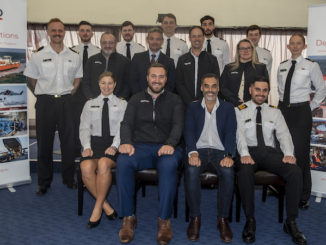



Serco CMO Dr Derrick Tin says wellbeing is shaped by leadership culture and that prevention and performance optimisation deliver greater impact than reacting to injury or burnout after the fact.
There are only a small number of Disaster Medicine specialists globally. Serco’s Chief Medical Officer Dr Derrick Tin is one of them. He’s also an Army reservist, a leading researcher on the health impacts of natural disasters and conflict events, and has undertaken extended humanitarian deployments at sea with the US Navy.
Today, Serco has about 2,500 health staff delivering exceptional healthcare across the Defence, Justice and Community sectors, including dedicated nurses and doctors supporting ADF personnel.
In his role with Serco’s Clinical Governance Unit, Dr Tin draws on his frontline experience and global advisory work as a subject matter expert (SME) in support of Defence’s readiness objectives, leveraging strong clinical governance expertise and an emphasis on holistic wellbeing.
“Ensuring a nation’s Line of Defence is combat-ready is ultimately about building resilience,” Dr Tin says.
Read it in the e-magazine…
The Athlete Analogy
The science behind maximising wellbeing and performance in high-pressure, high-stakes environments, which demand physical and mental endurance, has evolved significantly in recent years.
Dr Tin says there is an analogy to professional sport: “Elite athletes are now extending their prime into their mid-late 30s.
With advances in sports and performance medicine – from exercise monitoring to recovery science – we now better understand how prolonged stress affects the body and how to optimise rehabilitation.
That’s why the best athlete isn’t always on the court every second of the game. It’s about balance, sustainability and long-term performance.
“Wellbeing is really about enabling people to thrive across the full spectrum of service – physically, mentally, and socially – rather than viewing health as simply the absence of injury or illness.”
By analysing the volume and intensity of trauma exposure, we can work backwards to design more effective intervention models and better regulate how that exposure is managed over time.
Dr Tin’s research colleagues are currently piloting this concept with military personnel in Europe.
Their innovative program involves a cyclical model, with personnel spending a stint deployed in a high intensity combat environment, followed by intentional removal for a similar period into an environment where they can recover and reset. The findings may offer valuable insights into future intervention and workforce sustainability models for Defence.
The 5 Pillars of Resilience
Serco’s depth and breadth of expertise supporting Defence in the Asia Pacific and globally informs our world-leading health and training programs, bespoke for the armed forces.
“Our organisation has thousands of clinicians bringing deep, realworld expertise to Defence’s priorities and challenges, applying similar resilience-focused approaches across hospitals, military bases and justice facilities. Our US Army Holistic Health and Fitness (H2F) program exemplifies this, improving readiness and performance,” says Dr Tin.
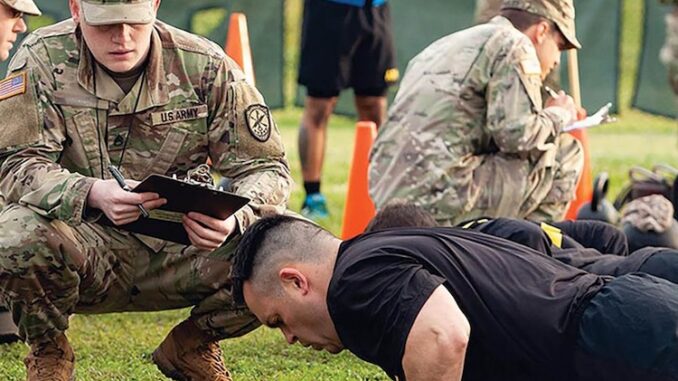
The H2F program Serco delivers for the US Army centralises 5 pillars: physical wellbeing, mental fitness, spiritual health, nutrition and sleep readiness. Through the program, Serco’s team of Strength and Conditioning Coaches and Cognitive Performance Specialists provides direct training support for 45 US Army brigades across 15 locations.
“Wellbeing is shaped by leadership culture more than any single program; people perform best when they’re enabled to speak up and seek support early.”
Serco’s H2F program team has over three decades of global experience supporting US military personnel. This ensures that the quality of H2F services provided to soldiers at installations worldwide is of an exceptional calibre, aligned to Defence’s goals for personnel readiness.
In the first three months of introduction alone, this program achieved a 140% lower increase in injury referrals and 23% greater increase in physical readiness pass rates, reflecting significant impact.
“Wellbeing is really about enabling people to thrive across the full spectrum of service – physically, mentally, and socially – rather than viewing health as simply the absence of injury or illness,” Dr Tin believes.
“That means investing in early intervention, human performance optimisation, strong positive leadership environments, and support systems that evolve with personal and organisational needs.
It’s also an asset that Serco provides hard and soft facilities management (FM) for military bases worldwide. We proudly offer renowned meal quality and ensure that the pursuit of optimal readiness outcomes begins right from the facilities where personnel sleep, exercise and train.
Health is more than treating disease or preventing illness. It’s about enabling individuals to perform at their best, and when you scale that across a team using all five pillars, health becomes a driver of resilience and productivity.
What it Takes to Deliver
Serco’s extensive workforce of GPs, nurses and allied health staff provide tailored support to Defence members and reservists. These clinicians are highly experienced and possess a deep understanding of the unique health requirements of serving Defence Force members. They have strong local knowledge of the remote communities in which many of them live and work themselves.
Clinical governance is also a key focus throughout Serco’s operations. Serco has a large, dedicated group of clinical governance SMEs, helping ensure clinicians deliver the very highest quality of healthcare to those who give the ultimate service to their country and communities.
Dr Tin’s research focuses on healthcare delivery in remote, complex and conflict environments, analysing factors influencing human performance, and how extraordinary events and new technologies impact population health. Using evidence-based science and medicine, his team researches pragmatic, innovative intervention models.
“Serco recognises that isolated services don’t create combat readiness,” he says.
“It comes from integrated systems connecting health and performance with practical operational delivery. Our experience supporting Defence, and in other high-risk environments globally, means we understand that sustaining people under pressure means combining clinical expertise, support structures and disciplined governance, supporting forces to remain combat-capable and mission-focused 24/7, 365.”
Top 3 Takeaways
Dr Tin believes leadership culture must complement science and Defence’s health systems to ensure combat-ready troops.
“First, wellbeing is shaped by leadership culture more than any single program; people perform best when they’re enabled to speak up and seek support early,” he says.
“Second, prevention and performance optimisation deliver greater impact than reacting to injury or burnout after the fact, and save costs in the long run. Stress inoculation, nutrition and effective recovery under load – these are critical.
And third, health systems must evolve alongside modern operational pressures; wellbeing challenges have changed. To recruit, build up, retain and support great talent today, mental wellbeing is a priority.”
Serco in New Zealand
Serco, as a trusted strategic Defence partner, brings both local and global best practice to our tailored service delivery for New Zealand and the New Zealand Defence Force (NZDF).
Jit Rathod, NZ Defence FM lead, says, “We’re proud to bring genuine on-the-ground capability to NZ’s Defence Estate, shaped by my extensive experience delivering FM for the NZDF and wider government across nationally-critical infrastructure, strengthened by Serco’s world class Defence and Health expertise. We embed innovation and resilience from day one.
“For us, it’s about enabling readiness and truly supporting the Defence community. We’re not here just as a provider. We’re here to stand shoulder to shoulder with the NZDF, delivering a best for site approach across every location in Aotearoa.”
Learn more: serco.com/aspac/ourwork/defence