



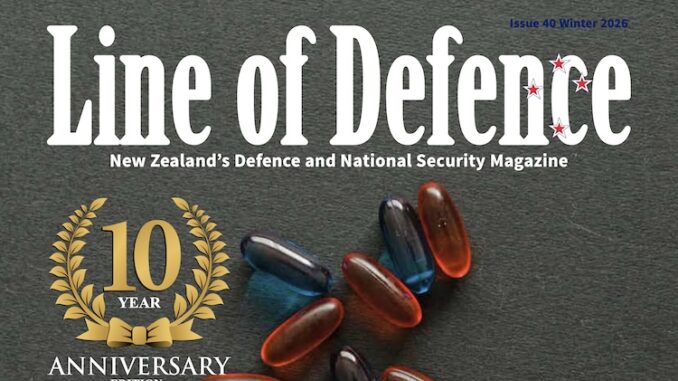
Kia ora and welcome to the Winter 2026 issue of Line of Defence – our 40th issue and 10th anniversary edition!
This issue’s font cover depicts red and blue pills, taking its metaphoric cue from the Wachowski’s 1999 film The Matrix. It’s a device that attempts to capture the either/or decisions and futures that our defence and national security-focused elected representatives, bureaucrats, academics, and suppliers are seemingly having to choose between.
Frigate or no frigate? Type 31 or Mogami? Larger or more? Crewed or uncrewed? Autonomous, or not? Is the world now more dangerous or just less certain than previously, or neither? Is Trump an exception to the rule or just a theatrical version of it? Is the Anzac partnership a myth or is there some real substance to it? Are we needing more rules in procurement or more agility?
View/download the full-colour e-magazine…
Many of the articles herein engage with these very questions. RADM Jim Gilmour ONZM (Retd) writes, for example, on the topic of frigate replacement, suggesting that the preferred choice is one that enables us to avoid ‘future regret’. In his piece, Dr Jim Rolfe writes that although closer NZ-Australia defence alignment is a recurring historical theme, it’s lacking adequate supporting structures to make it a reality.
It is particularly pleasing that this milestone edition has provided us with the largest-ever issue of Line of Defence, both in terms of page count and number of contributors. A sincere thank you to our contributing writers and interviewees, many of whom are joining us for the first time, and a few of whom have been with us from the start.
Wayne Mapp and Peter Greener have both contributed articles to LoD since 2016. Their intellectual generosity has been humbling. We’ve also been fortunate since early on to have had sitting several ministers and shadow spokespersons contributing to the conversation via the magazine, and they have added much interest to its pages.
As Chair of the NZDIA at the time we were getting started, Bernie Diver supported our socialisation into the defence industry, initiating a strong relationship between the magazine and the Association. Another key institutional partner is Massey University’s Centre for Defence & Security Studies, a relationship engineered by Professor Rouben Azizian many years ago.
Our sponsors have kept the publication sustainable, and we have been fortunate to have collaborated with many advertisers large and small over the past decade. On this note, I would like to specifically recognise General Atomics Aeronautical Systems (GA-ASI), who stands alone as our most committed and longest-running sponsor.
Over the coming month, we look forward to unveiling a new Line of Defence website and announcing the members of our new editorial board. These are among a range of initiatives aimed at bringing renewed sharpness and inclusivity to the public discussion on the defence and national security of Aotearoa.
Nicholas Dynon, Lincoln.