



New Zealand still has no specific plan for how it will reach its 2% of GDP Defence spend target, writes Wayne Mapp. But in order to spend an additional $16.5 billion over the next eight years, we’ll need one soon.
As I write this, the war against Iran is unfolding. My original intent had been to devote this article to Hon Judith Collins’ contribution to defence. Although I will deal with this in the second part of this article, it would be remiss to ignore the war.
President Trump, to a much greater extent than in his first administration, is committed to America First. This plays out in his approach to foreign policy, as much as it does in domestic policy.
Unlike previous United States administrations, President Trump makes no attempt to build international coalitions. Potential partners are seen as a burdensome impediment that invariably seek to limit the actions of the United States. It is much better to go alone.
However, in the Middle East, the key partner is Israel, which broadly shares the United States’ perspectives about the best way forward. Though some may argue that it is Israel which provides the key thinking for the United States’ strategic objectives for the region.
Read it in the magazine…
The America First approach means the current United States administration plays little heed to the niceties of international law in determining its actions. If the target state leadership is loathsome enough, their military capacity is limited enough and their removal will benefit the United States, then that is enough.
Having said this, it is worth noting that President Trump did pay some observance to the requirement of international law in stating that the United States was at risk of imminent attack by Iran. Not many international lawyers would think that the concept of ‘imminent’ covers risks that are some years away.
For the international community, and particularly friends and allies of the United States, especially in NATO and in the Pacific, there is no real risk that they will be asked to join in the unilateral military actions of the United States. These military adventures remain solely within the domain of the United States. All that is required is some formulaic response that does not overly antagonise the relationship.
This has been the approach of Australia, Canada, New Zealand and the United Kingdom. New Zealand’s response differed from that of its Commonwealth partners in that New Zealand does not support the attack, even if it accepts United States reasoning.
“The true measure of the commitment to 2% of GDP will only be evident when the government makes the major decisions in re-equipping the Navy.”
Major military actions always carry risks and consequences, some immediate and some longer term. These may not be confined to the specific region in which those actions are being carried out.
Other major powers will be carefully assessing the impacts of the United States’ actions. In particular, China does not see America as First in the world. Increasingly China sees their nation as an equal, and more specifically, as pre-eminent in East Asia.
The last 20 years has seen a dramatic build up in Chinese military capability. This has required Chinese defence expenditure to rise as a percentage of GDP. Most informed estimates consider that China spends about 2.5% of GDP on defence, which is somewhat more than Chinese official figures of 2%. However, at 2.5% Chinese military expenditure is still well short of that of the United States, which is 3.5% of GDP.
In my view, it is probable that China will progressively increase its defence expenditure to match that of the United States. This will ultimately add up to a 50% increase on current expenditure. This extra spending will be especially evident in air, naval and nuclear capability. China’s technological base is such that some of the capabilities will be world leading.
The pressure of substantially increased Chinese defence spending on Asia Pacific nations will be challenging. New Zealand will not escape this pressure. It is with this background that Hon Judith Collins’ contribution to defence can be assessed.
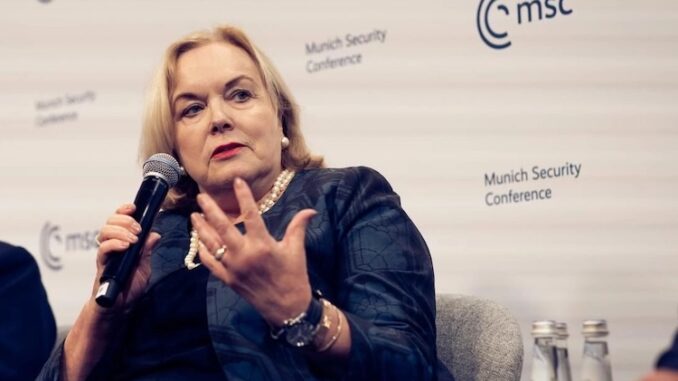
Judith Collins has had a Parliamentary career of 24 years. During this time, she was seldom out of the news. However, being newsworthy is only one part of a Parliamentary career, and not necessarily the most significant. It is the enduring decisions that really matter.
There is no doubt that her time as Minister of Defence will be seen as one of her career highlights. She did three particularly noteworthy things. She completed one of the most comprehensive Capability Plans of the last two decades; she ordered a significant upgrade in Airforce capability; and perhaps most significantly, she got a commitment from her Cabinet colleagues to increase defence expenditure to 2% of GDP by 2033/34.
The true measure of the commitment to 2% of GDP will only be evident when the government makes the major decisions in re-equipping the Navy.
Unlike the nations that New Zealand compares itself with, New Zealand has no specific plan to reach 2%. Australia intends to increase its defence expenditure from 2% of GDP to 2.3% by 2033/34. Importantly, the Australian government has provided the actual expenditure track that is needed to reach this goal. For the entire decade, $765 billion will be spent, which will reach the 2.3% goal. The United Kingdom, facing the NATO requirement of 3.5% of GDP, has had to make much bigger forward commitments.
“The ANZAC ships cost $750 million each, but that was 30 years ago. A comparable figure for 2026 would be close to $2 billion.”
Current New Zealand defence spending is $5.2 billion, or about 1.2 % of GDP. The government has committed an extra $9 billion over the next four years to fulfil the Capability Plan. Most of this additional expenditure is capital. Substantial extra expenditure will be needed over the next decade to reach 2% of GDP.
If New Zealand followed the Australian approach of specifically setting out how the 2% goal would be reached by 2033/34, then the government would commit to a defence budget of around $70 billion for the entire period. That requires an additional $20 billion over the decade above the current defence expenditure of $5.2 billion per year.
The first four years commits an additional $9 billion. That means the next five years, being 2029/30 to 2033/34, will require an additional $12 billion.
So far, the government has only announced capability commitments of $3.5 billion, these primarily being the Seahawk naval helicopters and the A321 aircraft to replace the B757. In addition, there are many smaller capital purchases that are made each year from existing capital within the ongoing $5.2 billion defence budget.
That leaves $16.5 billion out of the additional $20 billion that is yet to be allocated to any specific acquisition or operational requirement. Given that there is now only eight years left before 2033/34, there is not a lot of time to make the decisions that will result in spending the additional money.
There are, no doubt, plenty of choices on how to spend $16.5 billion. For instance, Australia is spending A$10 billion to buy 11 Mogami frigates. It seems unlikely that each ship will cost less than A$1 billion. A more credible figure would be A$1.5 billion or even A$2 billion. The ANZAC ships cost $750 million each, but that was 30 years ago. A comparable figure for 2026 would be close to $2 billion. Three Mogami ships would therefore cost $6 billion.
But there are plenty of other major naval and air assets that will need replacing over the next decade. HMNZS Canterbury, the two Offshore Patrol Vessels, the NH 90 fleet, and the ever-increasing demands of a network enabled NZDF with satellite capability and AI will all require substantial additional capital.
To spend $16.5 billion over the next eight years requires that all the major spending decisions be made in the next term of parliament. While it might be unrealistic to expect the government to set out the allocation of such expenditure prior to the election, it would be reasonable to expect a commitment to make the critical decisions during the parliamentary term 2026 to 2029.
The same might be expected of opposition parties, though it is unlikely that all, or any, of the opposition parties would actually commit to the 2% target.
However, it is the current government that has committed itself to the 2% target. It is therefore reasonable to expect the successor to Judith Collins to give a broad indication of how the extra money will actually be spent.