


Two Auckland-based technology companies have entered into a strategic partnership to develop and manufacture launch and recovery systems for uncrewed surface vessels, targeting defence and government customers across the Indo-Pacific.
New Zealand’s emerging uncrewed maritime systems sector has a new entrant with the launch of Edge Autonomy Limited and the announcement of a partnering agreement with Auckland-based manufacturer Tectrax Limited.
Established to take New Zealand-developed uncrewed maritime technologies from prototype through to production, Edge Autonomy is developing a portfolio of products for defence, government and scientific operators across the Indo-Pacific.
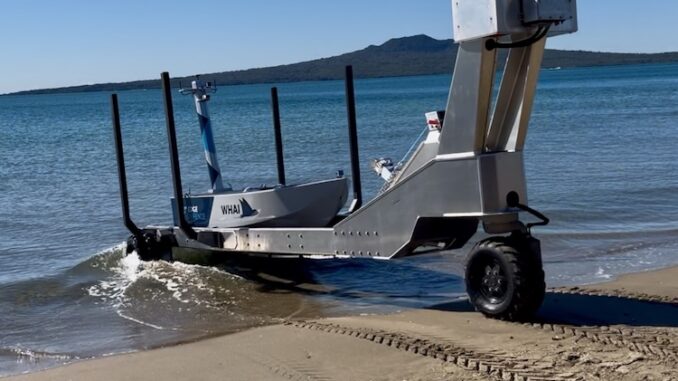
The company’s portfolio includes the Whai uncrewed surface vessel (USV) and the Pāpaka uncrewed vessel launcher, with the latter representing the first product to emerge from the partnership with Tectrax.
Under the agreement, Tectrax will contribute its established electric drive and control technology and manufacturing capability, while Edge Autonomy will provide systems integration, autonomy expertise, and the certification and qualification pathways required by defence and regulated maritime customers.
Moving beyond the prototype
Central to the partnership is addressing a challenge facing the uncrewed maritime systems sector internationally – the ability to transition from individual prototypes to affordable, operationally deployable systems manufactured at scale.
“Uncrewed maritime capability is being held back by cost and by logistics, not by autonomy,” said Edge Autonomy Director John Gell.
“We can build clever robots whether they be land, surface, sub-surface or air. What has been missing is the ability to put them into the operational theatre anywhere, repeatedly, affordably, and without putting people into danger while doing so.”
By combining established domestic manufacturing capability with in-house systems integration, the companies intend to address production volumes and unit costs from the outset of product development.
“Tectrax has the manufacturing and the drive technology. We have the integration and the defence pathway,” said Gell. “Together we can build this here and build it at a price that lets customers field it properly.”
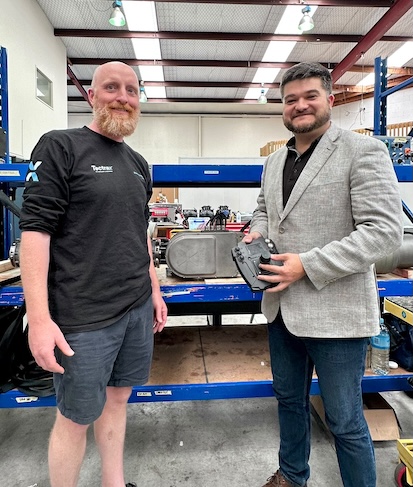
John Gell and James Morton, CEO of Tectrax and Zerojet. Image supplied.
New Zealand manufacturing with local industrial participation
The partnership will adopt a modular manufacturing model under which common drive, power, control and autonomy modules are produced in New Zealand and exported either as complete systems or in kit form.
Platform-specific components, including cradles and frames configured to accommodate particular vessels and operating environments, can be fabricated in the customer’s own country.
According to the companies, the approach is intended to reduce freight costs and delivery lead times, facilitate adaptation to individual customer requirements, and provide opportunities for industrial participation in export markets – a consideration for defence customers subject to domestic industry participation requirements.
Addressing the launch and recovery challenge
While considerable attention has been directed towards the development of increasingly sophisticated uncrewed maritime platforms, their deployment and recovery remain significant logistical considerations, particularly in littoral environments.
USVs reliant on wharves, cranes or crewed support vessels are constrained by the availability of infrastructure and personnel. The Pāpaka is being developed to enable vessels to be launched and recovered directly from beaches without personnel entering the water.
Tectrax designs and manufactures remotely operated electric launch and recovery systems at its Mount Wellington facility in Auckland. Its existing Boat-Launcher platform enables vessels to be launched and recovered from beaches and ramps without the need for a tow vehicle.
The Pāpaka is being developed alongside the Whai USV, enabling the vessel and its launch and recovery system to be engineered as an integrated capability.
The first integrated launcher is currently under construction, with vessel trials planned for early 2027. The companies intend to market the combined system to defence and government customers in New Zealand, Australia, the Pacific and the wider Indo-Pacific.






Be the first to comment