


Royal New Zealand Navy, New Zealand Customs Service and Fiji joint operation deploys USVs for persistent maritime surveillance in EEZ.
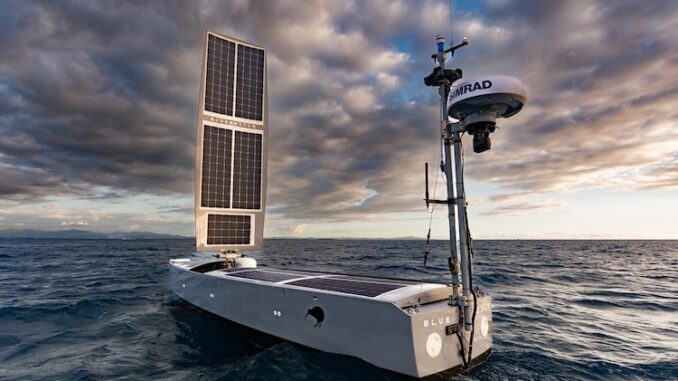
At the request of the Government of Fiji, the jointly owned RNZN and Customs Uncrewed Surface Vessels (USV) Tahi and Rua have carried out a four-week deployment in the waters of Fiji’s EEZ.
The USVs were delivered to Nadi by a Royal New Zealand Air Force C-130J Hercules, and then transported by road to Vuda Marina between Nadi and Lautoka to be launched.
Together, the USVs identified 137 vessels of interest that required additional scrutiny during a 24/7 surveillance of known maritime routes.
Powered by a combination of wave, solar and wind energy, the USVs are capable of remaining at sea for weeks at a time, operating around the clock without requiring resupply.
“This technology is fundamental in supporting Fiji’s fisheries and border surveillance, environmental monitoring and the protection of the country’s extensive maritime domain”.
Equipped with an array of high-tech surveillance, positioning and photographic systems, Tahi and Rua continuously reported their location and observations back to a monitoring centre.
The operation aimed to enable the Republic of Fiji Military Forces to develop a clearer understanding of activity across the region, including volume and patterns of maritime traffic.
The insights generated may, in the future, assist Fiji in identifying vessels that do not conform, allowing an interception, boarding and thorough search.
Intelligence on suspicious vessels sourced by NZCS may also be passed to RNZN controllers in a monitoring centre. A USV could be moved to areas where vessels of interest are known to operate or where illicit cargo may be transferred.
Fiji’s Maritime Essential Services Centre (MESC) in Suva is assessing the information obtained by the USVs during this operation.
“The ultimate goal is to ensure we have persistent presence, feeding back here into the MESC,” said MESC director Lemeki Lenoa. “Not only do the USVs help us address issues around manning, but it allows us to address the fuel crisis, because they are completely green-powered.
“We can deploy them into areas to help understand what is happening in our maritime domain, and that helps us – Navy, Customs, Fisheries, Police – develop capabilities and capacity to better respond to threats.”
The MESC was designed to bring partner agencies and nationalities under one roof, to address shared challenges in the region, he said.
“With all the support we’ve received so far, it’s helped us achieve actionable, tangible outcomes, by being able to provide intelligence or information to our partner agencies who can then prosecute these cases successfully in court.”
“This technology is fundamental in supporting Fiji’s fisheries and border surveillance, environmental monitoring and the protection of the country’s extensive maritime domain,” said Chief of the Fijian Navy, Commodore Timoci Natuva.
“Illegal narcotics entering our country is causing so much harm and misery to our people, so any means to combat this is beneficial to the nation.”
The operation builds on the strong defence and security relationship between New Zealand and Fiji. The Duavata Partnership, signed by the two countries in 2022, identifies defence cooperation, maritime security, border protection, capability development and responses to transnational threats as shared priorities.







Be the first to comment