




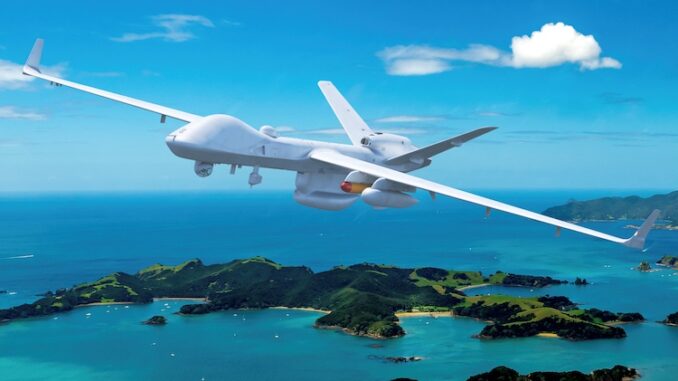
Chinese Navy drills in the Tasman highlighted the potential cost-effectiveness of airborne surveillance with the General Atomics Aeronautical Systems MQ-9B SeaGuardian Remotely Piloted Aircraft System (RPAS).
Earlier this year, a Chinese People’s Liberation Army-Navy (PLA-N) Task Group (TG), comprised of a cruiser, frigate, and replenishment vessel, completed a circumnavigation of Australia. This was an unprecedented show of force, and the furthest south a PLA-N TG had ever sailed. The live-fire drills that were conducted in the Tasman Sea on 21 February with extremely short notice to the Australian and New Zealand Ministries of Defence raised serious regional concerns.
New Zealand and Australia committed air and sea assets to surveil the PLA-N TG. Both nations had to surge capability to conduct surveillance, raising questions about the adequacy of each nation’s capabilities — particularly if such Chinese operations were to become the norm. And if a PLA-N attack submarine were to accompany the TG, how much more difficult and taxing would it be to detect and track this boat?
This episode highlighted the cost-effectiveness of performing such surveillance with General Atomics Aeronautical Systems, Inc.’s (GA-ASI) MQ-9B SeaGuardian® Remotely Piloted Aircraft System (RPAS) when compared to higher-cost capital ships and aircraft.
The detection and surveillance of a transiting naval task group can be achieved through a range of systems, including satellites, maritime surface vessels (crewed and uncrewed), and airborne surveillance assets (also crewed and uncrewed).
Satellites provide a ready option if access is available and real-time updates are not necessary. However, satellite surveillance can only deliver the awareness component.
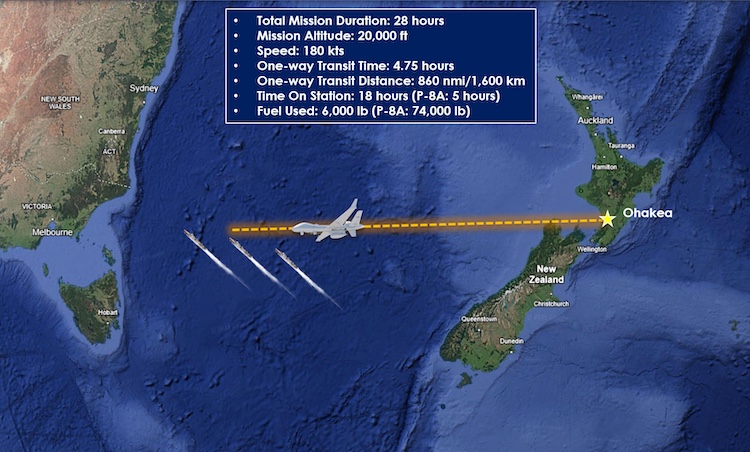
Depiction of potential MQ-9B SeaGuardian performance in the Tasman Sea.
For an on-water response capability, maritime surface vessels are a solid option but present relatively high operating costs. Arguably, costs can be reduced for uncrewed vessels, but such capabilities are still maturing.
Traditional airborne surveillance assets like crewed maritime patrol aircraft have strong dash speed and reasonable endurance but are also costly and present challenges for crewing, particularly if sustained operations are required.Capable, mature uncrewed aircraft like the MQ-9B SeaGuardian offer a system that exhibits excellent range and endurance, and is far more cost-effective than using capital ships or crewed aircraft for surveillance.
While high-cost assets like navy ships and traditional aircraft are effective for short periods, they aren’t sustainable for prolonged operations. This becomes particularly problematic if frequent task group monitoring becomes necessary.
Monitoring a transiting task group requires a continuous presence to demonstrate resolve. In and of itself, the surveillance task is not especially demanding and does not warrant the use of key capital surface or airborne assets and their associated crews. These should be preserved for more complex military and security roles — not exhausted by performing tasks that more cost-effective systems can provide.
If a response is needed, especially against a capable maritime TG with long-range and anti-surface capabilities, the survivability of crewed assets must be considered. For offensive action, highly capable joint forces would be necessary. The SeaGuardian, integrated with advanced air-launched cruise missiles under development, could deliver a valuable stand-off targeting and strike advantage.
The scenario where a PLA-N TG operates within the South Pacific islands might present an even more challenging scenario than the recent operations. Under such circumstances, New Zealand may need to lead the response and significantly surge its Navy and Air Force. This scenario further strengthens the case for employing a SeaGuardian RPAS.
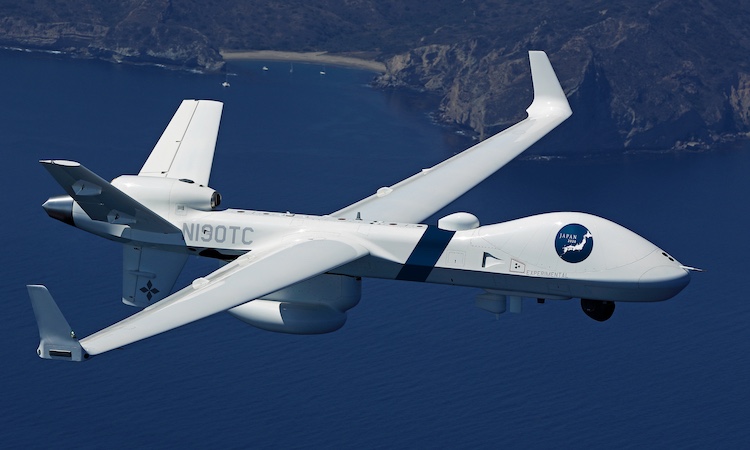
The Japan Coast Guard began operating a GA-ASI MQ-9B SeaGuardian in 2022.
Similar to task group monitoring, routine civil surveillance should not be performed using high-end military surface or airborne assets.
For the scenario in which the PLA-N TG operated in the Tasman Sea and conducted live-fire drills, SeaGuardian — operating from RNZAF Base Ohakea, for example — could provide the required 18 hours of persistent coverage in the area of operations, delivering a high-fidelity radar capability, electro-optical imaging, and electronic surveillance. With two aircraft, effective 24-hour monitoring of the TG could be achieved, delivering pattern-of-life data and a continuous presence. Both standoff and close surveillance could be conducted in all-weather conditions.
If the TG included a submarine presence, it would pose an even greater challenge for the New Zealand and Australian Defence Forces. Detecting and tracking submarines requires a versatile surface airborne asset like the MQ-9B SeaGuardian that performs at a high operational tempo. MQ-9B can deploy and monitor sonobuoys, detect threats, and localise subsurface contacts while relaying tracking data to networked platforms, making it an ideal complement to existing surface and airborne anti-surface warfare (ASW) assets.
GA-ASI’s MQ-9B SeaGuardian offers a highly cost-effective solution for routine surveillance and is being adopted by an increasing number of other nations, including key regional allies of both New Zealand and Australia.
The need for cost-effective maritime surveillance is likely to increase over time, and current capital surface and airborne assets are not suited for routine, persistent surveillance.
The MQ-9B SeaGuardian RPAS is a practical, cost-effective solution that delivers critical airborne intelligence while preserving higher-end assets for demanding military and civil security roles.